
See the Whole Alignment
Standing, weight-bearing images show how your spine, pelvis, hips, and lower extremities work together. This gives your care team a more complete view of your overall alignment—not just one isolated area of the spine.
Standing imaging and individualized planning help us understand how your spine aligns with the rest of your body.
Explore how it informs care ↓Our team currently uses EOS at St. Mark’s Hospital, with an additional system planned for our office. EOS imaging and EOS Insight are part of our approach to evaluation, surgical planning, and follow-up.
Standing, weight-bearing images show how your spine, pelvis, hips, and lower extremities work together. This gives your care team a more complete view of your overall alignment—not just one isolated area of the spine.
Precise measurements and 3D planning tools help your surgeon evaluate your individual alignment and anatomy. This information can be used to help personalize surgical planning rather than relying on a one-size-fits-all approach.
EOS allows your care team to compare alignment before and after treatment. This helps track changes alongside your symptoms, function, and recovery.
More complete imaging. More precise measurements. Less radiation exposure.
Individualized care is central to our approach. We consider your anatomy alongside your symptoms, daily life, and goals. EOS helps us understand your alignment in greater detail so that those conversations—and the treatment decisions that follow—are grounded in information specific to you.
EOS uses X-rays to capture front and side views while you are upright. Those views help the team assess how the spine, pelvis, and lower limbs align under the weight of the body.
The images add context to your examination and symptoms. Your surgeon decides which studies are appropriate for the questions your evaluation needs to answer.
EOS Insight turns the images into alignment measurements and 3D planning information. If surgery is being considered, your surgeon can use those measurements to explore a proposed correction in a model based on your anatomy and assess how it would affect alignment.
The platform also allows comparison of alignment before and after surgery. That gives the team a way to review changes over time alongside your symptoms, function, and recovery.
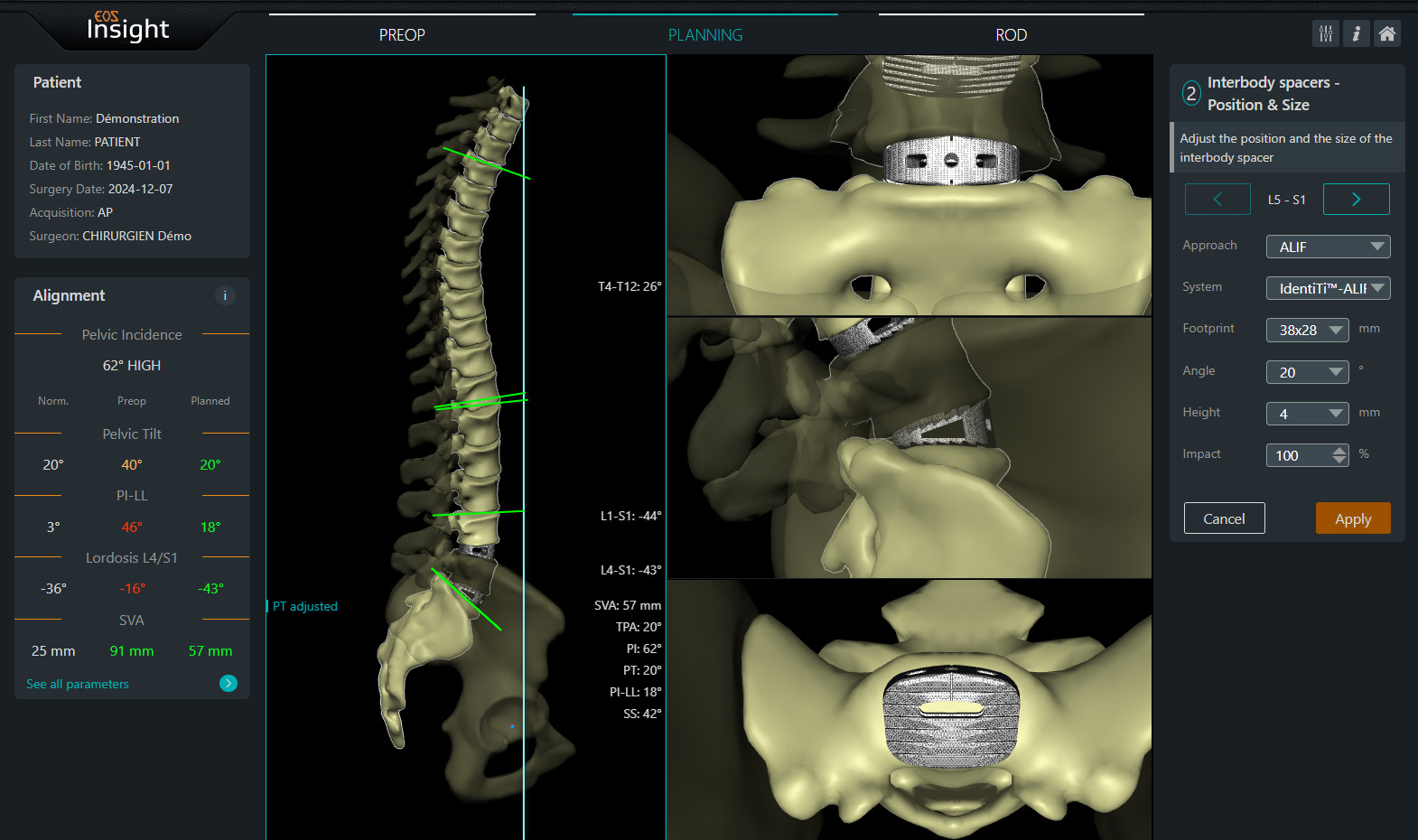
Imaging is one part of your evaluation. We bring the findings together with your examination, medical history, treatments you have tried, and what you want to get back to. This helps us explain the reasoning behind a recommendation and discuss the options and tradeoffs with you.
Having an EOS scan does not mean you need surgery. Your surgeon recommends imaging and treatment based on your individual needs. Technology informs the plan; decisions are made with you, and planning software does not guarantee a particular result.
Explore our approach to individualized care →EOS can use less radiation than conventional X-rays of comparable anatomy. The actual dose depends on the exam, patient, and acquisition settings. This is relevant when repeated images are needed to follow alignment over time.
EOS complements other studies such as MRI or CT when those are needed; it does not replace every type of spine imaging.
During your consultation, we can discuss how alignment relates to your condition and whether additional imaging would help. Our team will explain where a recommended study takes place.
Request My Consultation →Current hospital use and the planned office system reflect the practice’s September 2026 update.
Talk with our team about your symptoms, imaging, and goals.